How to Play Dominoes
To play dominoes, shuffle a double-six set face down, take seven tiles each for two players (five each for three or four), and place the highest double to start. Take turns adding one tile to either open end of the line, matching the number of pips. If you cannot play, you draw from the boneyard in the Draw game, or simply pass in the Block game. The round ends when someone plays their last tile or nobody can move, and the player with the fewest pips left scores the difference.
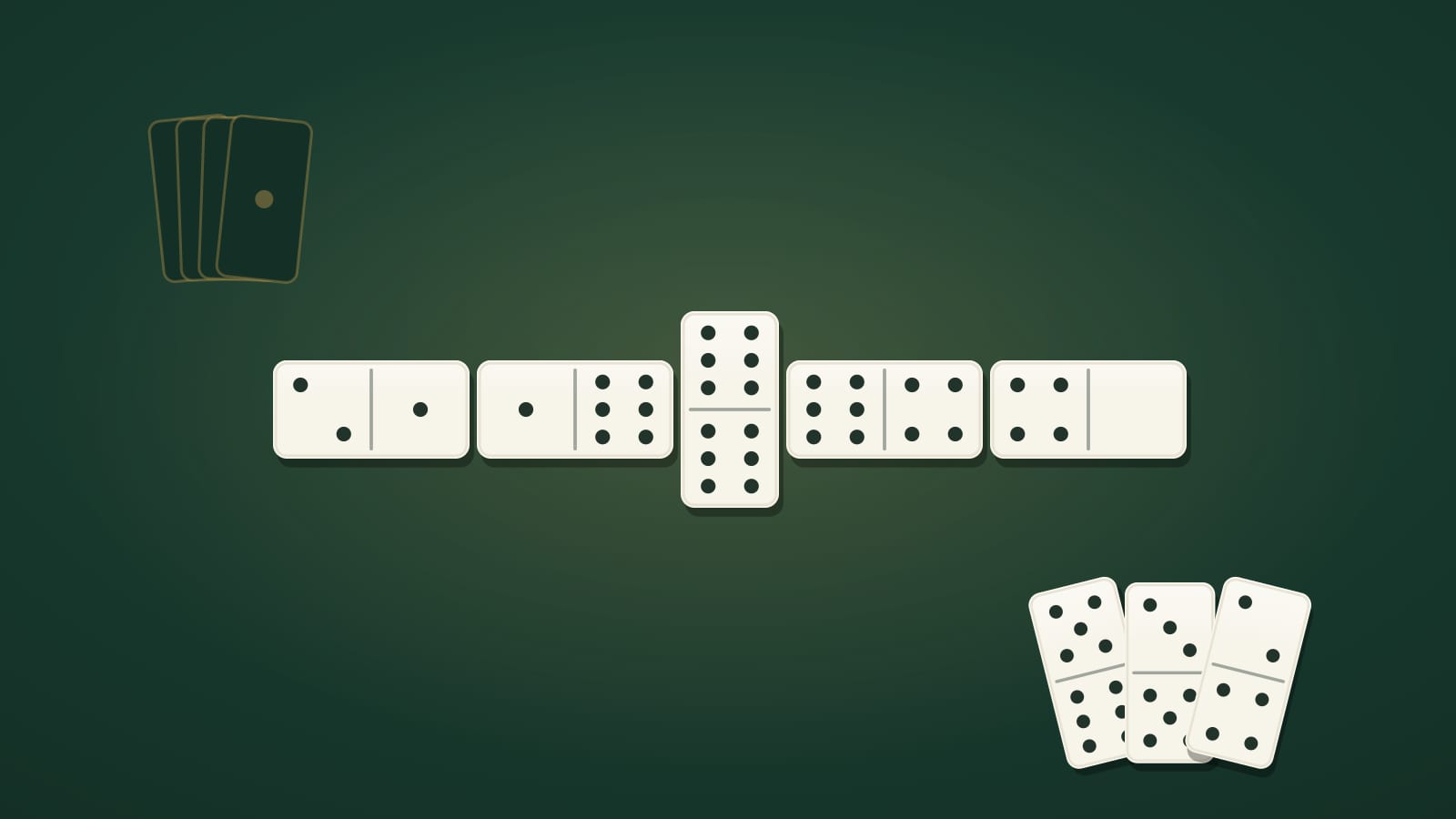
What you need
A double-six set (28 tiles, 168 pips in total) covers two to four players and is the set nearly every household already owns. Larger sets exist for bigger tables and for Mexican Train.
| Set | Highest end | Tiles | Total pips | Players |
|---|---|---|---|---|
| Double-six | 6 | 28 | 168 | 2–4 |
| Double-nine | 9 | 55 | 495 | 2–6 |
| Double-twelve | 12 | 91 | 1092 | 2–10 |
| Double-fifteen | 15 | 136 | 2040 | 4–12 |
| Double-eighteen | 18 | 190 | 3420 | 6–14 |
Every tile is divided into two ends, each carrying between zero and six pips on a standard set. There is exactly one tile for each unordered pair, so the 3–5 and the 5–3 are the same tile, and a set contains no duplicates. Tiles with the same number at both ends are doubles, and the seven of them are the awkward, valuable tiles that decide most rounds.
You will also want something to keep score on, because pips add up fast, and a game usually runs to 61 or 100 points across several rounds rather than being settled in one.
How to play dominoes, step by step
These are the rules of the Draw game, which is the version most people mean by "dominoes". The Block game is identical except that there is no drawing. The difference is explained in full below.
Shuffle and deal
Turn all 28 tiles face down and swirl them around. Two players take seven tiles each; three or four players take five each. The tiles nobody took stay face down in a pile called the boneyard.
Decide who opens
Whoever holds the highest double leads, and must lead with that tile. If nobody was dealt a double, which happens in roughly three deals in a thousand with seven tiles each, the heaviest tile leads instead.
Match the open ends
Play passes to the left. On your turn, add one tile to either end of the line so that the touching ends have the same number of pips: a 4–2 can go onto an end showing 4, or onto an end showing 2. The number you did not match becomes the new open end.
Lay doubles crosswise
A double is traditionally placed at right angles to the line. In the basic game this is decoration, since the line still has two ends, but it matters in All Fives, where a crosswise double at an end counts both of its halves towards the score. Many American households go further and treat the first double as a spinner, branching the line off all four sides. That is a popular variation rather than the base rule, and both positions are set out with their sources in "The rules people argue about" below.
Draw when you cannot go
If no tile in your hand matches either open end, take tiles from the boneyard until you can play one. The last two tiles of the boneyard are never drawn: once only two remain, a player who cannot go passes instead.
End the round
The round ends the moment somebody plays their last tile and calls "domino", or when the line is blocked and no player can move. Either way, everyone counts the pips still in their hand.
Score and deal again
The player with the fewest pips wins the round and scores the total of everyone else’s pips, minus their own. Shuffle and deal again. The match goes to 100 points with two players, or 61 with three or four.
Block or Draw: the two games behind “dominoes”
Almost every argument about "the real rules" comes down to this. Block and Draw are the same game apart from one rule, whether the boneyard is live, and that one rule changes the game far more than it sounds like it should.
| Block | Draw | |
|---|---|---|
| Boneyard | Dead: the leftovers are not used | Live: draw until you can play |
| If you cannot play | You pass | You draw, then pass only if the boneyard is down to two |
| Deal (2 players) | 7 each | 7 each |
| Deal (3 players) | 5 each | 7 each |
| Deal (4 players) | 5 each | 6 each |
| Rounds that end blocked | 61% | 19.2% |
| Match target | 100 (2 players) · 61 (3–4) | 100 (2 players) · 61 (3–4) |
That blocked-round figure is the reason the distinction matters. In the Block game, 61% of two-player rounds end with the line jammed and tiles still in every hand, so the blocked-game scoring rule is not an edge case you can settle later, it decides the majority of rounds. In the Draw game it falls to 19.2%, because a player who cannot go refills instead of stalling.
This is also where a lot of published rules go wrong. Wikipedia’s dominoes article describes the Block game as one in which a player unable to move "must continue drawing tiles from the stock", which is the Draw game. Pagat is unambiguous: in Block, a player who cannot play passes, and the boneyard is not used at all.
How scoring works
The winner of a round scores the pips their opponents are still holding. The detail worth settling before you start is whether the winner subtracts their own remaining pips. Respected sources genuinely differ, and on a blocked round the two rules give different answers.
Pagat’s rule is that the lowest hand "is credited with the sum of the scores of the losers, minus his own total". The version repeated on most other sites drops the subtraction and simply awards the total of everyone else’s pips.
When somebody empties their hand the two rules agree, because the winner has nothing left to subtract. They diverge only on a blocked round, which in the Block game is most rounds. The game on this site implements both; the toggle is in Options, and the full worked comparison is on the scoring page.
- Everyone counts the pips left in their hand. A 6–4 is ten, a 3–3 is six, a 0–0 is nothing.
- The lowest total wins the round.
- That player scores the sum of everyone else’s totals, minus their own if you are using pagat’s rule.
- If two players tie for lowest, nobody scores.
- First to 100 (two players) or 61 (three or four) wins the match.
The rules people argue about
Dominoes has no governing body, which is why two rule books can both be right. Rather than quietly pick one, here is who says what, so you can settle it at your own table and know you are not simply misremembering.
| Question | Positions | What to do |
|---|---|---|
| How many tiles does each player draw? | pagat, Block: 7 for two players, 5 each for three or four.; pagat, Draw: 7 for two players, 7 for three, 6 for four.; Common household practice: 7 each for two players, 5 each for three or more, regardless of game. | There is no single official deal. Two players take 7 in every source; beyond that, agree the number before the first tile is laid. Fewer tiles in hand means a longer boneyard and a slower, more tactical round. |
| When the game blocks, does the winner subtract their own pips? | pagat: Yes: the lowest total scores the sum of the others, minus their own remaining pips.; Most published summaries: No: the winner simply takes the total of everyone else’s pips. | Both are played. They give the same answer when someone empties their hand and different answers on a blocked round, so settle it before you start rather than during the argument. |
| Is the first double a spinner you can build on all four sides? | pagat, Block and Draw: No. The layout is a single line with two ends.; Common American house rules: Yes: the first double is a spinner and the line branches from it. | Spinners are a genuine and popular variation, not the base rule. They matter enormously in All Fives, where extra ends mean more scoring chances. |
| How many tiles does each player draw in Mexican Train? | pagat: Up to 4 players take 15, 5–6 take 12, 7–8 take 10, 9–10 take 8.; Wikipedia: Publishes ranges rather than fixed numbers: for a double-twelve set, 12–16 for two players, 10–15 for three, 11–14 for four, 9–12 for five to eight. | Pagat’s fixed numbers are the cleanest starting point. The ranges exist because the right hand size depends on how long a game the table wants. |
| Is the double-blank worth 50 penalty points? | pagat: No: it is not mentioned. Tiles score their pips, so the double-blank scores 0.; Wikipedia: Lists it as an option: blanks “could be scored” as 25 each, with the double-blank at 50. | It is a house rule, and a popular one, because a 0-value tile is otherwise a free pass to hold. If you want it, agree it before the deal. |
Common questions
How many dominoes do you get each?
- In a two-player game, seven each. That is the one figure every source agrees on. For three or four players it varies: pagat’s Block rules say five each, its Draw rules say seven for three players and six for four, and many households simply deal five each regardless. Agree it before the first tile goes down; fewer tiles in hand means a bigger boneyard and a slower, more tactical round.
Who goes first in dominoes?
- The player holding the highest double leads, and must open with that tile. If nobody holds a double the heaviest tile leads instead, but with seven tiles each that almost never happens, because somebody is dealt a double in 99.7% of deals.
What happens if you cannot play a domino?
- In the Draw game you take tiles from the boneyard until you find one you can play. In the Block game there is no drawing at all, so you simply pass and play moves on. In either game, once the boneyard is down to its last two tiles nobody may draw, so you pass.
What is the boneyard in dominoes?
- The boneyard is the pile of face-down tiles left over after the deal. In the Draw game you take from it when you cannot play; in the Block game it is not used at all. Its last two tiles are never drawn.
Do you have to play a domino if you can?
- Yes. You may choose which end to play on and which tile to use, but you may not pass while holding a legal move. Passing when you could have played is how a blocked round gets manufactured, which is exactly what the rule prevents.
What does it mean when dominoes is “blocked”?
- A round is blocked when no player can legally play and the boneyard is exhausted or unavailable. Play stops immediately and everyone counts the pips still in hand, and the lowest total wins the round. Roughly six in ten Block-game rounds end this way, against fewer than two in ten Draw-game rounds.
How many dominoes are in a set?
- A standard double-six set has 28 tiles and 168 pips in total. A double-nine has 55 tiles, a double-twelve 91, a double-fifteen 136 and a double-eighteen 190. The pattern is that a double-N set holds (N+1)(N+2)/2 tiles.
Why are there 28 dominoes in a set?
- Because a double-six set holds every unordered pairing of the numbers 0 to 6, including each number with itself. That is 21 mixed tiles plus 7 doubles, which is 28. No combination is duplicated, which is why the 6–3 and the 3–6 are the same tile.
How much is a spinner worth in dominoes?
- Nothing on its own. A spinner is a branching rule rather than a scoring one, so playing it earns no points by itself. What it changes is the shape of the layout: extra open ends mean more places to play and, in All Fives, more ends whose pips are added up when scoring.
What is a spinner in dominoes?
- A spinner is a double that the line is allowed to branch from, so the layout gains extra ends to play on. It is a popular variation rather than the base rule. Pagat’s Block and Draw rules keep the layout to a single line with two ends. Spinners matter most in All Fives, where more open ends mean more chances to score.